EZO Bearing Series Final Chapter: Bearing Damage Analysis and Solutions
Bearings serve as core components in precision transmission systems. Their failures typically stem from improper handling, incorrect mounting, insufficient lubrication, abnormal loads, inadequate sealing, and environmental corrosion. Based on the precision manufacturing expertise of Nippon Precision Bearings Co., Ltd., EZO’s official technical documentation systematically summarizes typical bearing damage modes, root causes, and corresponding remedies, providing a complete diagnostic and maintenance framework for reliable equipment operation and extended service life. This article, derived from official technical materials, delivers a comprehensive analysis of common bearing failures and forms a practical guide for on-site troubleshooting and maintenance.
1. Flaking: Typical Fatigue Failure
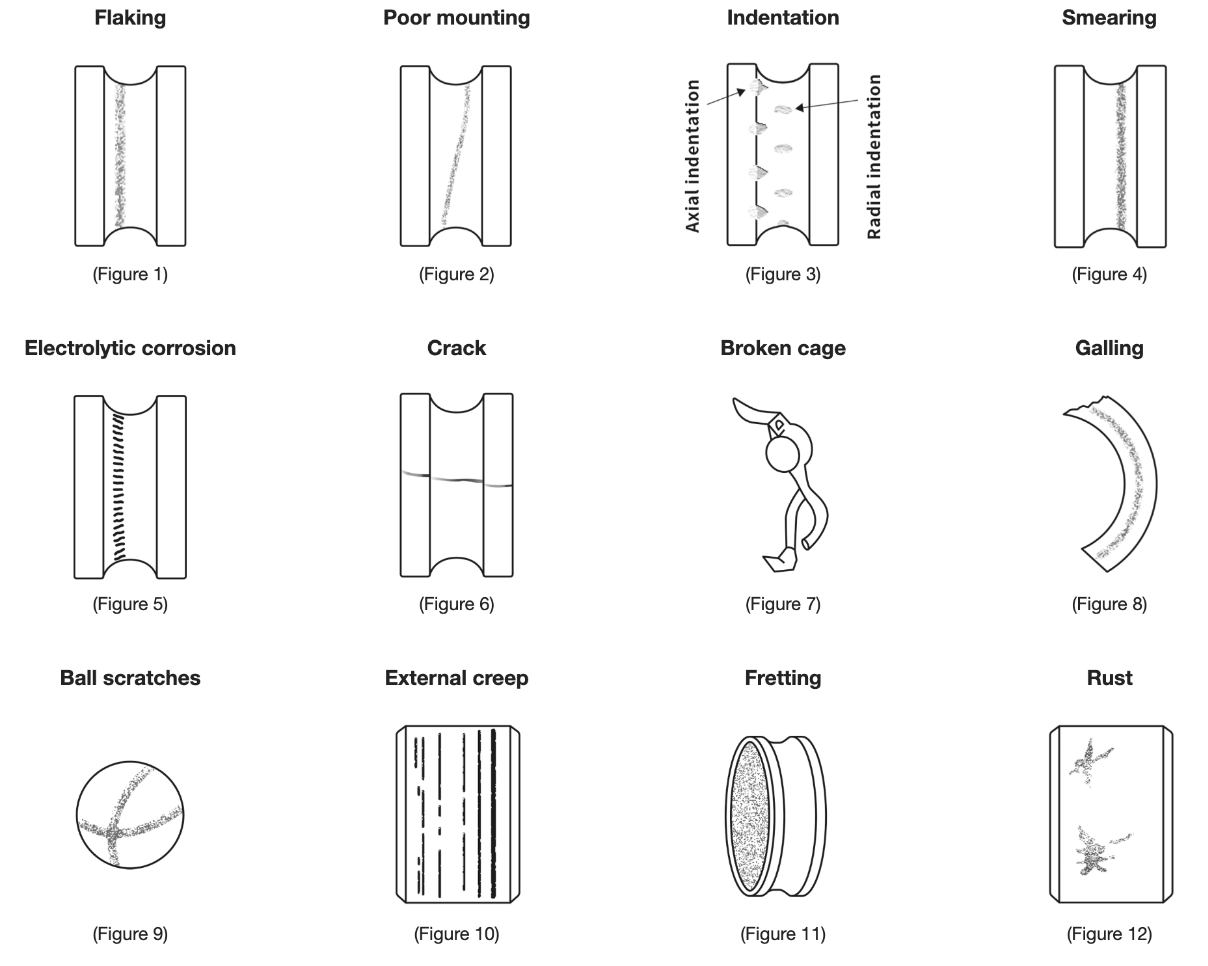
Flaking refers to the spalling of metal from the raceway or rolling element surface and is the most common fatigue failure, closely related to load conditions, alignment, internal clearance, and lubrication.
Full-circumference flaking on one side of the raceway: Caused by abnormal axial loading. A clearance fit should be used for the outer ring of the non-locating bearing to accommodate axial thermal expansion.
Ball-pitch flaking: Caused by impact loads during mounting or rust during downtime. Bearings should be mounted carefully, and anti-rust treatment applied during long-term shutdowns.
Premature flaking on raceways and balls: Triggered by excessive load, insufficient clearance, poor lubrication, mounting errors, or corrosion. Load settings, fits, lubrication, and shaft/housing accuracy must be standardized.
Inclined flaking: Results from poor alignment, shaft deflection, or low shaft/housing accuracy. Realign components properly and select higher-clearance bearings when necessary.
Flaking at symmetrical positions: Mainly caused by low housing accuracy. Refinish the housing bore to restore dimensional and perpendicularity accuracy.
Solution principle: Prioritize alignment and fitting, restore proper clearance, standardize lubrication and mounting procedures, and avoid impact and uneven loading.
2. Indentation: Surface Damage from Impact and Contamination
Indentations appear as pits matching the ball pitch on the raceway, often formed during mounting, dropping, or under low-speed heavy loading.
Impact during handling or dropping: Creates regular ball-pitch indentations. Handle bearings gently and avoid dropping or striking.
Excessive static or low-speed load: Exceeds the static load rating. Re-calculate and control static loads.
Ingress of sand or metal particles: Causes irregular indentations and scratches. Thoroughly clean shafts and housings and improve sealing arrangements.
Solution principle: Standardize handling and mounting, control static loads, strengthen dust sealing, and prevent hard particles from entering the bearing interior.
3. Seizure: Critical Thermal Failure
Seizure is characterized by discoloration, adhesion, and even melting of raceways and balls, representing severe overheating failure.Main causes: Excessive load, insufficient internal clearance, lack of lubrication, and incorrect mounting.Remedies: Ensure proper fits and clearance, apply the correct type and amount of lubricant, and verify mounting methods and related component accuracy.
4. Smearing: Adhesion Caused by Slip and Poor Lubrication
Smearing involves softening and welding of material onto raceways and balls, primarily caused by insufficient lubrication or ball slippage.
Inadequate lubrication leading to oil film breakdown: Use suitable lubricants in sufficient quantities.
Ball slippage: Apply proper preload to improve stability under high-speed and variable-speed conditions.
5. Electrolytic Corrosion: Current-Induced Corrugated Damage
Corrugated patterns on raceways indicate electrolytic corrosion caused by electric current arcing through the bearing.Remedy: Ground or insulate the bearing to block shaft currents and prevent electrical damage.
6. Breakage: Structural Failure from Overload and Defects
Breakage includes ring cracking, ball fracturing, and cage breakage, usually caused by impacts, excessive interference, poor lubrication, or foreign material entanglement.
Ring cracking: Results from excessive impact load, extreme interference fit, or progressed flaking/seizure. Regulate loads and fits and address early damage promptly.
Ball fracturing: Caused by severe impact or abnormal operating clearance. Check mounting, load conditions, fits, and bearing clearance.
Cage breakage: Induced by moment loads, high-speed / high-acceleration impact, inappropriate lubrication, or entangled debris. Handle carefully, optimize lubrication, and improve sealing.
Solution principle: Strictly control interference fits, avoid shock loads, resolve early failures, and enhance lubrication and contamination control.
7. Galling, Wear and Fretting
Galling: Scuffing between raceways and balls due to unsuitable lubrication or sudden acceleration. Use softer grease and avoid rapid starts.
Abnormal wear: Caused by foreign debris, rust, and poor lubrication. Strengthen sealing, anti-rust protection, and lubrication management.
Creep (fitting surface wear): Due to insufficient interference or loose sleeve fastening. Increase interference and properly tighten the sleeve.
Fretting (reddish wear): Caused by tight fitting clearances. Increase the interference fit.
False brinelling: Ball-pitch fretting due to vibration during transport or small oscillating movements. Secure shafts and housings, use oil lubrication, and apply preload.
8. Rust and Corrosion: Chemical Damage from Environment and Lubrication
Rust occurs on bearing surfaces, interiors, or fitting surfaces. Corrosion results from acids, alkalis, gases, or reactive lubricants.
Rust from poor storage or condensation: Improve storage conditions, control humidity, and apply anti-rust measures.
Fretting rust on fitting surfaces: Increase interference and apply oil to mating surfaces.
Chemical corrosion: Inspect seals and switch to compatible lubricants.
Solution principle: Control moisture, improve sealing, apply protection, use corrosion-resistant materials and compatible lubricants, and eliminate corrosion sources.
9. Diagnosing Load and Mounting Conditions from Rolling Tracks
Observing raceway contact patterns allows quick judgment of load direction, magnitude, rotation conditions, and mounting faults.
Unidirectional radial load (inner ring rotating): Inner ring track is centered, full-circumference, and uniform width; outer ring track is widest in the load direction and tapers outward.
Combined radial and axial load: Tracks shift toward the axial load side; inner ring track is full-circumference and uniform; outer ring track may be full or partial.
Moment load: Outer ring track is diagonal with varying width; inner ring track remains centered and uniform.
Oval housing deformation: Outer ring track is widest at the compressed zone; circumferential length varies with deformation and clearance.
Abnormal tracks directly indicate uneven loading, misalignment, or housing deformation, enabling rapid root-cause identification.
10. Conclusion: Key Points for EZO Bearing Full-Life Protection
Mounting: Avoid impacts, ensure alignment and perpendicularity, and apply proper fits and clearance.
Load: Prevent overloading, uneven loading, and shock loads; verify static and dynamic load ratings.
Lubrication: Select correct lubricants, maintain proper volume and replacement intervals, and prevent contamination.
Sealing: Protect against dust, water, and chemical ingress; inspect seals regularly.
Alignment: Ensure shaft and housing accuracy to eliminate tilt, deformation, and eccentricity.
Protection: Control humidity and prevent rust; secure and protect bearings during storage and transport.
Monitoring: Detect early abnormalities via temperature, noise, vibration, and lubricant condition.
Bearing failures are rarely accidental; most result from preventable human and environmental factors. Mastering EZO’s official damage analysis and solutions significantly reduces failure rates, extends service life, lowers maintenance costs, and delivers consistent, reliable support for precision equipment.