The Link-Belt Series 300 Tapered Adapter Bearing Unit
In the world of bulk material handling and heavy-duty industrial machinery, the interface between the rotating shaft and the stationary frame is a critical stress point. When I look at the Link-Belt Series 300, I don't just see a bearing; I see a specific engineering solution designed to tackle the harsh realities of misalignment, shock loads, and the need for rapid maintenance.
This isn't a standard-duty bearing. It is explicitly engineered for applications where you cannot afford to sacrifice speed for load capacity. Based on the technical specifications, here is a breakdown of why this unit exists and how it functions.
1. The Core Problem: Shaft Fixation & Alignment
One of the most common failure points in mechanical power transmission is the slip or fretting corrosion between the bearing bore and the shaft. The Series 300 addresses this head-on with its tapered adapter design.
The Tapered Principle: Unlike a simple set-screw bearing that relies on friction points, the tapered adapter (PU3K or PA3) acts like a wedge. When you tighten the locknut, the inner ring is drawn up the taper.
Concentricity: This mechanical action forces the bearing to center itself perfectly on the shaft. This isn't just about ease of installation; it is about maximizing shaft-bearing balance. If you are running a high-speed fan, this concentricity is non-negotiable for vibration control.
Anti-Rotation Pin: Notice the specific mention of an anti-rotation pin. This is a critical safety feature. If the load is unbalanced (which is common in mixers or conveyors), this pin prevents the ring from spinning inside the housing, which would otherwise destroy the bore.
2. Performance Metrics: Why Choose This Over a Roller Bearing?
The data sheet provides a compelling argument: 30% more load capacity per shaft size compared to medium-duty ball bearings.
Speed vs. Load: Many engineers face the trade-off between using a ball bearing (fast, but lower load) or a roller bearing (high load, but slower and noisier). The Series 300 attempts to bridge this gap.
Surface Finish: The "Super-finished" races are a key detail. In high-speed applications, surface finish directly impacts the hydrodynamic film of the lubricant. A smoother race reduces friction, which translates to lower operating temperatures and significantly longer service life. It also explains the "exceptionally quiet operation" noted in the specs—critical for environments where noise pollution is a concern.
3. Sealing Strategy: Keeping the Enemy Out
In dusty or wet environments, the seal is the frontline defense. The Series 300 uses a bonded elastomeric seal retained by a snap ring.
Blowout Prevention: The snap ring retention is vital. During re-lubrication, high grease pressure can often blow out a standard seal. This design prevents that.
The Flinger Effect: The inclusion of a stainless-steel guard that rotates with the shaft is a smart touch. It acts as a centrifugal flinger, throwing debris away from the seal lip. This is a passive, maintenance-free method of keeping contaminants at bay.
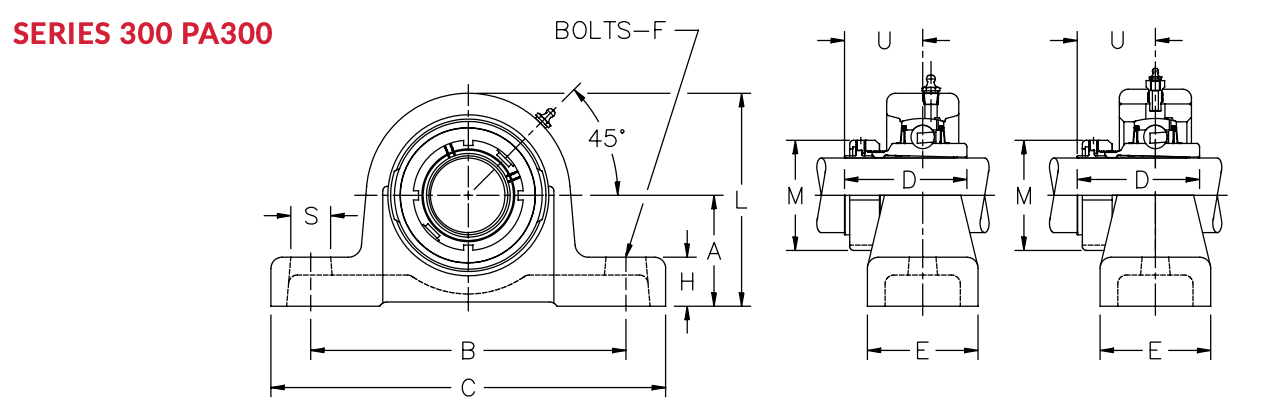
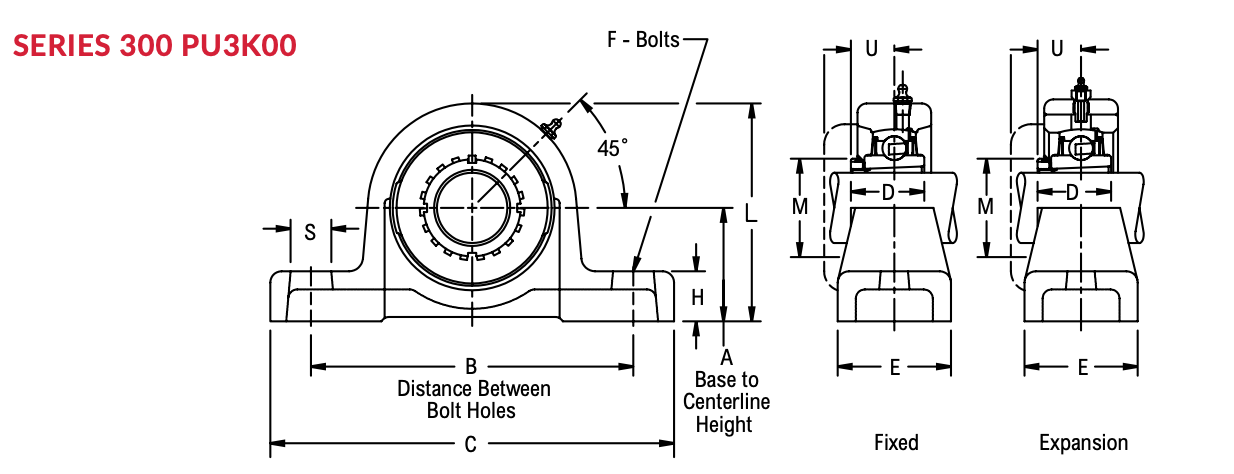
4. Dimensional Data & Specifications
For the practical application, here is the hard data extracted from the technical documentation. This table focuses on the PA300 (Shurlok Adapter) series, which is the standard configuration for these units.
Series 300 PA300 Dimensions (Inches)
表格
Note: The PU3K00 series utilizes a different adapter sleeve system and has slightly different dimensional profiles, typically used where specific clearance or specific fitment is required.
5. The "Expansion" Factor
You will notice the table above includes "Fixed" and "Expansion" units.
Fixed Units: Used where the bearing housing is bolted solidly to the base.
Expansion Units: Used on the "free" end of a shaft to accommodate thermal expansion. The housing slides on the base, preventing thermal locking of the shaft. The anti-rotation pin is essential here to prevent the housing from spinning with the shaft while still allowing axial movement.
The Link-Belt Series 300 is not a generic bearing. It is a specialized tool for the mechanical engineer. If you are designing a system that requires high-speed operation (fans, pumps) combined with the ruggedness needed for industrial environments (conveyors, mixers), this unit provides a robust solution. The combination of the tapered adapter for zero backlash and the heavy-duty cast iron housing makes it a reliable workhorse where maintenance downtime is expensive.
When selecting your size, pay close attention to the shaft diameter tolerance. While the tapered adapter is forgiving, ensuring you have the correct adapter code (PA3 vs PU3K) is crucial for the mechanical integrity of the installation.